

Dann auch von mir ein: Daumen hoch!
Sieht klasse aus. Das mit dem Rost auf dem Boden vermisse ich persönlich nicht.

Dann auch von mir ein: Daumen hoch!
Sieht klasse aus. Das mit dem Rost auf dem Boden vermisse ich persönlich nicht.
Hey Tom, ich finde deine Anlage, auch echt Klasse!
Ist der Rost gebrusht und gepulvert oder hast du die Sachen einfach raus gelegt?
Hallo,
schön, dass Euch mein neues Scrap Yard gefällt. Danke für die positive Rückmeldung.
An die Betonteile müssen noch Spuren dran. Ich bin mir jedoch noch nicht so ganz im Klaren, wie diese in der nachgestalteten Situation aussehen würden. Das mit dem Rost überall auf dem Boden ist so eine Sache. Hier mal das Ergebnis, welches bei der Google-Bilder-Suche "Scrap Yard" rauskommt. Man kann da nicht wirklich sagen, dass auf den Bildern der Boden überall im landläufigen Sinne "rostrot/rostbraun" ist. Auch auf Filmen sieht man eher keinen "rostroten/rostbraunen" Boden. Hier ein Beispiel von der Chicago Terminal Railroad, deren Strecke u.a. ein Scrap Yard durchquert. Die Böden sehen doch eher "normal" schmutzig aus. Und doch sind sehr sicher alle Böden mit Rost bedeckt. Und auch bei meinem Yard ist der gesamte Boden mit Rost bedeckt - mit echtem. Jedoch sieht alter Rost dunkelbraun bis fast schwarz aus. Hier mal ein paar Bilder von dem Rost, welchen ich verwendet habe.
Thank you for liking my new scrap yard. Thanks for the positive feedback.
The concrete parts have to be scratched. However, I'm not quite sure what they would look like in the redesigned situation. That with the rust all over the floor is such a thing. Here's the result, which comes out in the Google images search "Scrap Yard". One can not really say that in the pictures the ground is everywhere in the popular sense "rusty red / russet brown". Also on films you do not see a "rusty reddish brown" ground. Here'san example from the Chicago Terminal Railroad, whose route traverses a scrap yard among other things. The floors look rather "normal" dirty. And yet all floors are covered with rust. And even at my yard, the entire floor is covered with rust - with real. However, old rust looks dark brown to almost black. Here are a few pictures of the rust, which I have used.
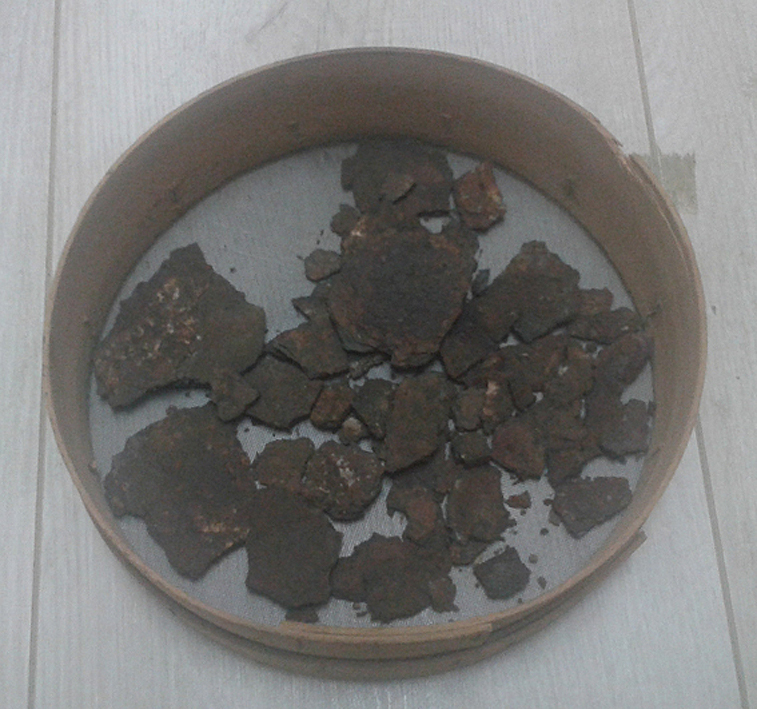
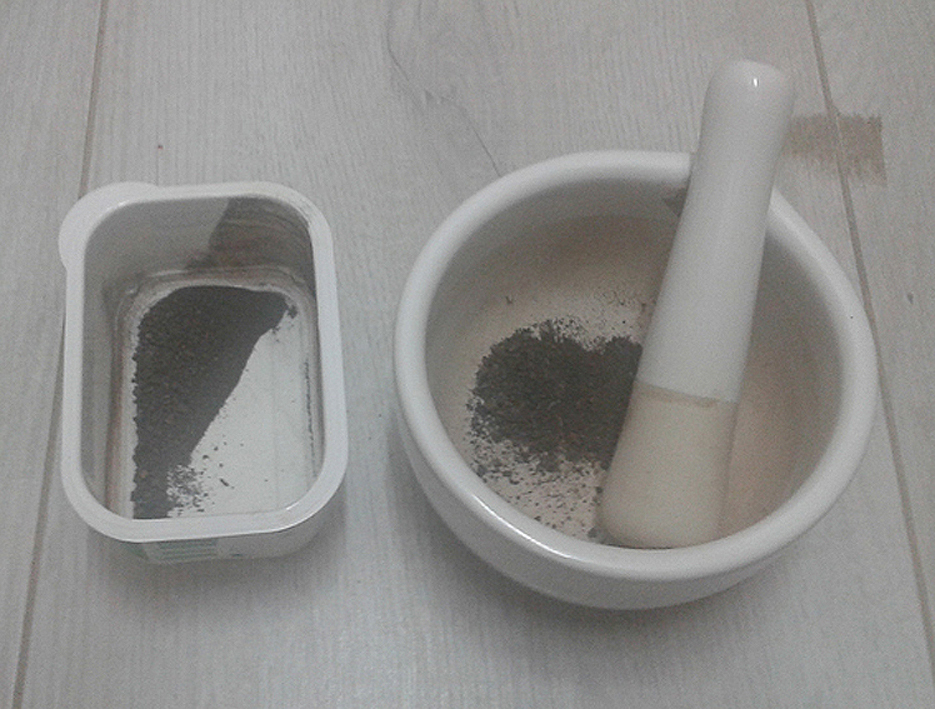
Das sind "Rostschwarten", die sich an lange der Witterung ungeschützt ausgesetzten Eisenteilen bilden. Diesen Rost kann man mit einem Mörser zu Pulver zermahlen. Dieses ganze dunkle Zeug auf dem Boden ist dunkler alter gemalener Rost in seinen verschiedenen dunklen Abstufungen. Normaler Dreck eben. Frischer Rost sieht gelblich, rötlich bis bräunlich aus und ist auf den Schrothaufen, an den Schienen, Radsätzen, Drehgestellen und dem Kesselwagenrahmen zu sehen. (Es tut mir sehr Leid, dass ich keine besseren Bilder hinbekomme.)
Den "künstlichen" Rost habe ich mit ROST-EFFEKT herghestellt.
These are "rust rinds" that form on parts of iron that have been exposed for a long time to the weather. This rust can be ground with a mortar to powder. All this dark stuff on the ground is dark old gritty rust in its different dark shades. Normal dirt just. Fresh rust looks yellowish, reddish to brownish and can be seen on the scrap heaps, on the rails, wheelsets, trucks and the tankcar frame. (I am very sorry that I can not get better pictures.)
The "artificial" rust I have with RUST-EFFEKT produced.
Grüße Tom
@Micha
Ich sehe das wie Tom, es wäre rötlicher, wenn es gerade geregnet hätte und Pfützen stehen, aber ich glaube, bei Tom regnet es nicht durch 
Ach ja, sieht toll aus 
Frage, der Bagger mit dem tollen Schrotgreifer, woher, von wem, wie, was, 
Hallo Tom,
schöner Schrott! 
Sven
Hallo Maurice,
der Lader ist das farblich veränderte Ergebnis des Kibri Bausatzes 11282. Bei ihm muss allerdings auch noch etwas mehr "Zeit" aufgetragen werden. Ich habe lange nach einem passenden Lader mit diesem typischen Schrottgreifer bei US-Modellen gesucht, jedoch nichts passendes gefunden und dann den Liebherr-Lader genommen. Ich denke, er kommt vom Gesamteindruck her den typischen Ladern auf US-Schrottplätzes sehr nahe. Zuerst wollte ich eigendlich einen US-Lader mit dem Greifer des Liebherrladers ausrüsten. Da aber schon aus dem Liebherr ein ausreichend gut aussehendes Gerät gemacht werden konnte, siegte die "ressourcenschonendere" Lösung  . Und hier ist er auch im Einsatz (7. u. 10. Bild).
the loader is the color-changed result of the Kibri Kit 11282. However, there must be some more "time" applied to it. I have long searched for a suitable loader with this typical scrap gripper on US models, but found nothing suitable and then I took the Liebherr loader. I think it comes from the overall impression of the typical loaders on US scrap yards very close. At first I really wanted to equip a US loader with the gripper of the Liebherr loader. But since the Liebherr could be made a sufficiently good-looking device, won the "resource-saving" solution ;). And here it is also in action (7th & 10th image).
Grüße Tom
Danke Tom, für die schnelle Antwort,
Tom, Gegenargument. Der Schrott, der ver- oder umgeladen wird, ist doch in den seltensten Fällen schon Jahrzehnte alt. Das heißt, er könnte durchaus hell sein und somit auch die kleinen Reste auf dem Boden. Ich rede ja nicht von flächendeckender Einfärbung.
Aber so what ... es muss dich überzeugen.
Hallo Micha,
stimmt .
right .
Grüße Tom
Hallo Tom.
Sehr schöner Schrottplatz. Mir gefällt das sehr gut.
Ich überlege auch schon seit geraumer Zeit letztlich bei mir mit switchlist zu fahren. Deine Ausführungen waren da auch recht hilfreich.
Grüße, Chris.
Gesendet von meinem LG-H815 mit Tapatalk
Hallo Chris,
danke für's Lob.
Ja, ein Car-Routing-System ist auf jeder betriebsorientierten Anlage sehr zu empfehlen. Es strukturiert zum einen die Sessions und gibt ihnen eine Richtung und macht zum anderen die Anlage größer, da dadurch auch mit wenigen Fahrzeugen sehr interessante und ggf. umfangreiche Situationen entstehen können, die es "abzuarbeiten" gilt (natürlich mit vorbildgerechten Geschwindigkeiten usw.). Das erfordert dann einige Zeit und damit empfindet man die Anlage größer.
Thank you for your praise.
Yes, a car routing system is highly recommended on any operation-oriented layout. On the one hand, it structures the sessions and gives them a direction and, on the other hand, makes the layout larger, as it can result in very interesting and possibly extensive situations even with a few vehicles that need to be "processed" (of course with prototypical speeds, etc.). This will take some time and you will feel the layout bigger.
Grüße Tom

Hallo Tom!
https://youtu.be/kYovzfNiFKQ Hier, das wäre was für Dich!.................für mich aber auch.
Hallo in die Runde,
das ist ja Super, der Regler. :woot: Weiß vielleicht schon jemand was neues darüber? 
Danke.
Oder hierhttp://protothrottle.com/:alles was Du wissen solltest.
Das mit den Endungen ändern ging schneller als erst gedacht. Hier sind wieder alle Bilder zu sehen.
Grüße Tom
Super Tom.
Dankeschön 
Hier gibt es noch ein Video von dem neuen Handregler: http://mrv.trains.com/how-to/d…engineering-protothrottle
Die Preise sind aber auch nicht von schlechten Eltern: https://www.iascaled.com/store/MRBW-CST
482,- $ fuer den Fahrregler plus 99,- $ extra fuer einen passenden Receiver muss man erst mal haben...
Liebe Gruesse
Matthias
Hier sind wieder alle Bilder zu sehen.
Moin, Tom,
jetzt habe ich auch endlich mal Deine Schrottplatzbilder angeschaut. Sieht super aus. Von wegen Rost auf dem Gelände sehe ich keinen Bedarf. Mir kommt nur die Liebherr Umschlagmaschine irgendwie sehr groß vor, die müßte doch eigentlich von der Breite her fast in die Gondola hineinpassen. War Kibri da etwas großzügig?
Grüsse,
Peter
Hier habe ich die Masse her: http://www.ritchiespecs.com/sp…odel=A934C&modelid=108531
Die Gondola kann beim Vorbild je nach Typ innen auch ein paar Zentimeter schmaler sein, zudem ist beim Modell das Innenmaß wegen der Wandstärken auch immer noch kleiner, aber gefühlt nach Foto fehlt da richtig viel.
Du hast noch kein Benutzerkonto auf unserer Seite? Registriere dich kostenlos und nimm an unserer Community teil!

